Why it matters

How Medicare pays for a diabetes outcome, and what we built before advising on it.

The home page is short on purpose. This page keeps the reasoning and every source: how Medicare pays for the same outcome on three rails, where the patient lands in the Star Ratings, the loop from a home reading to a payment, and the pipeline we built. The model and the services have their own pages.

How Medicare pays

Two sides of Medicare pay for the same outcome, on three rails.

On the Medicare Advantage side, the plan's Star Rating sets its payment: four stars or better raises the benchmark by 5 percentage points (10 in double-bonus counties), and the rating sets the rebate share, 70% at 4.5 stars or higher, 65% from 3.5 to 4.5, 50% below. Networks that move the diabetes measures negotiate a share of those dollars.

On the Original Medicare side, the same measures sit inside MIPS, which adjusts a clinician's Part B payments by up to 9 percent either way; inside the shared savings of an ACO; and inside the ACCESS Model from CMS, whose cardio-kidney-metabolic (CKM) track names type 2 diabetes as its example condition and pays $420 a year per aligned patient, half of it against outcomes.

21 pts
of Star Rating weight sit in the nine measures one patient with type 2 diabetes and hypertension can count toward (CMS, 2027)
52%
of Americans 65 and older have prediabetes, a qualifying condition for the ACCESS eCKM track; 40.1 million have diabetes, at $413 billion a year in medical costs and lost productivity (CDC, 2022 estimate)
$420 / yr
ACCESS payment for a patient with type 2 diabetes on the CKM track, half held back until outcomes are reconciled (CMS)
$13.4B
Medicare Advantage quality bonus spending in 2026; only 68% of enrollees sit in a bonus-eligible plan, down from 75% (KFF)
The Patient

One patient, nine measures, two ways CMS pays for the outcome.

Type 2 diabetes sits at the center: a leading driver of heart disease that is preventable, treatable, and often reversible, yet health promotion and reimbursed care still run on separate rails. One patient with diabetes can count toward the blood sugar, medication adherence, kidney, eye exam, and statin measures, and nearly always the blood pressure measures too. Each measure has its own eligibility rules, and a plan is rated on its whole contract.

The record goes silent at the facility boundary. Diabetes management depends on data generated between visits, and almost none of it reaches the record in a standardized, actionable form. Where uncontrolled glucose, weight trajectory, and falling activity are among the strongest predictors of 30-day readmission, that gap is a preventable source of admissions. Between visits, most teams still run on phone calls and patient recall.

The evidence is in. A 48-week multicenter randomized trial in 294 adults with type 2 diabetes integrated glucose, blood pressure, weight, and step counts from connected home devices, with photo-based diet logging. Both platform arms lowered HbA1c and weight more than routine care, with the largest gains in the arm that added clinician feedback and intermittent continuous glucose monitoring. Among the limitations the authors named: the devices that could connect to the platform were limited to certain products. That is the gap a device-agnostic FHIR platform closes.

The dose nobody can verify. The ADA Standards of Care recommend resistance exercise for type 2 diabetes, 2 to 3 sessions a week. The clinical verb is still counsel, not prescribe, because delivery outside supervised settings cannot be verified. Steps and heart rate stream from home devices; the resistance dose streams from nowhere. That is the gap our research line aims to close.

Where the patient with diabetes lands in Stars
2027 measureCategoryWeight
Diabetes Care: Blood Sugar ControlledIntermediate outcome3
Medication Adherence for Diabetes Medications (Part D)Intermediate outcome3
Controlling Blood PressureIntermediate outcome3
Medication Adherence for Hypertension and for Cholesterol (Part D)Intermediate outcome3 each
Plan All-Cause ReadmissionsOutcome3
Kidney Health Evaluation for Patients with DiabetesProcess1
Diabetes Care: Eye Exam; Statin Use in Persons with Diabetes (Part D)Process1 each
Getting Needed Care, Care Coordination, Rating of Health Care Quality (CAHPS)Patient experience2 each

Source: CMS, 2027 Star Ratings Measures and Weights, Tables 1 and 2. Nine clinical measures, 21 weight points, that one patient can count toward; the rating itself is computed contract-wide against cut points CMS sets after the year ends. Patient experience measures dropped from weight 4 to 2 with the 2026 ratings, which pushed these clinical measures to the front.
How Stars Move

Three thresholds, one loop, one patient.

Measure

Capture at home

Glucose, blood pressure, weight, heart rate, and steps from the devices the patient already owns, coded to LOINC the day they are taken. Verified resistance exercise joins them as the research line matures.

Triage

Act on the exception

A glucose drift, a pressure climb, a weight jump, or a collapsing step count reaches the care team as a flag, not a chart review, so the medication change happens before the emergency department does.

Document

Prove the outcome

The same observations build the ACCESS report and the MIPS quality numerators in US Core FHIR, and count for the blood pressure and diabetes Star measures, without a second workflow.

Earn

Cross the line

3.5 to 4.0 stars switches on the quality bonus. 4.0 to 4.5 lifts the rebate share to 70%. In the initial period, CMS releases the withheld half of an ACCESS payment when at least half of aligned patients meet their targets and spending on substitute services stays under CMS’s threshold; below either line, CMS reduces it by up to half. Star Ratings use care from about two years earlier and set the bonus for the year after they are published, so a measure moved this year reaches a plan’s bonus in about two to three years.

The Proof

Before advising anyone on the standard, we built to it.

The founder built a pipeline that ingests glucose, blood pressure, weight, heart rate, and steps from consumer devices across brands, normalizes every observation to LOINC, and emits US Core 6.1.0 FHIR R4 resources. Its blood pressure, body weight, and BMI observations validate against US Core 6.1.0 with zero errors in the official HL7 FHIR validator with live terminology.

That pipeline is not what we sell. It is how we know what passes. A client buys the judgment it produced: the assessment, the conformance check, the program design, the sprint, each at a fee fixed in writing.

The research line. A retrofit sensor that records resistance training on the gym equipment already installed, so the exercise dose becomes a verified, reportable event beside the glucose it is meant to move. Patent pending. Not a product today, and not FDA cleared.

FHIR R4US Core 6.1.0LOINCCMS ACCESS reporting APIHL7 validator 6.9.9
How we work
  • No patient data in any consulting engagement, so no business associate agreement.
  • Fixed fees, quoted in writing before work starts. Never a share of your Medicare payments.
  • Operational and technical review, not legal, billing, or compliance counsel. Not affiliated with CMS.
  • Virtual delivery, Hudson Valley roots, national reach.

See the nine engagements

Evidence

What passes, and what a report looks like.

Official result
0
errors, official HL7 FHIR validator v6.9.9
Blood pressure, body weight, and BMI observations against US Core 6.1.0 profiles with live terminology (tx.fhir.org), validated June 8, 2026.

Run with the ACCESS draft guide package current in June 2026 loaded and scored against the US Core 6.1.0 profiles that guide requires, for the blood pressure, body weight, and BMI observations. It is not a certification of an ACCESS submission; only CMS’s own response to a submission is. The guide is a draft and CMS revises it, which is why the retainer re-runs the check at every revision. Full validator output for any sample on request.

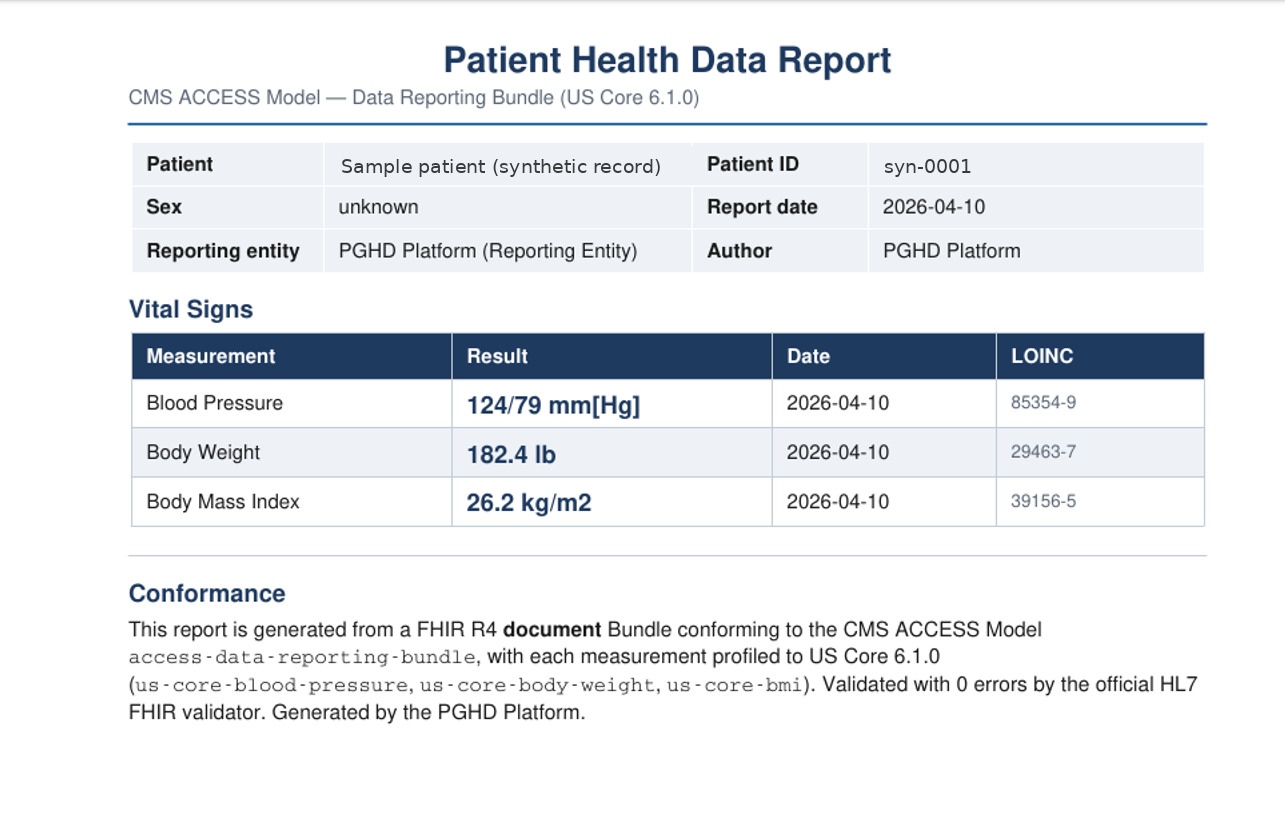
A human-readable render of an ACCESS data reporting bundle for a synthetic patient: vital signs with LOINC codes and a conformance statement
The render our pipeline produces from a reporting bundle, here for a synthetic record. Every value carries its LOINC code; the blood pressure, weight, and BMI observations in it passed the US Core 6.1.0 validation with zero errors. A client receives the same render for its own bundles, plus the raw validator output.